
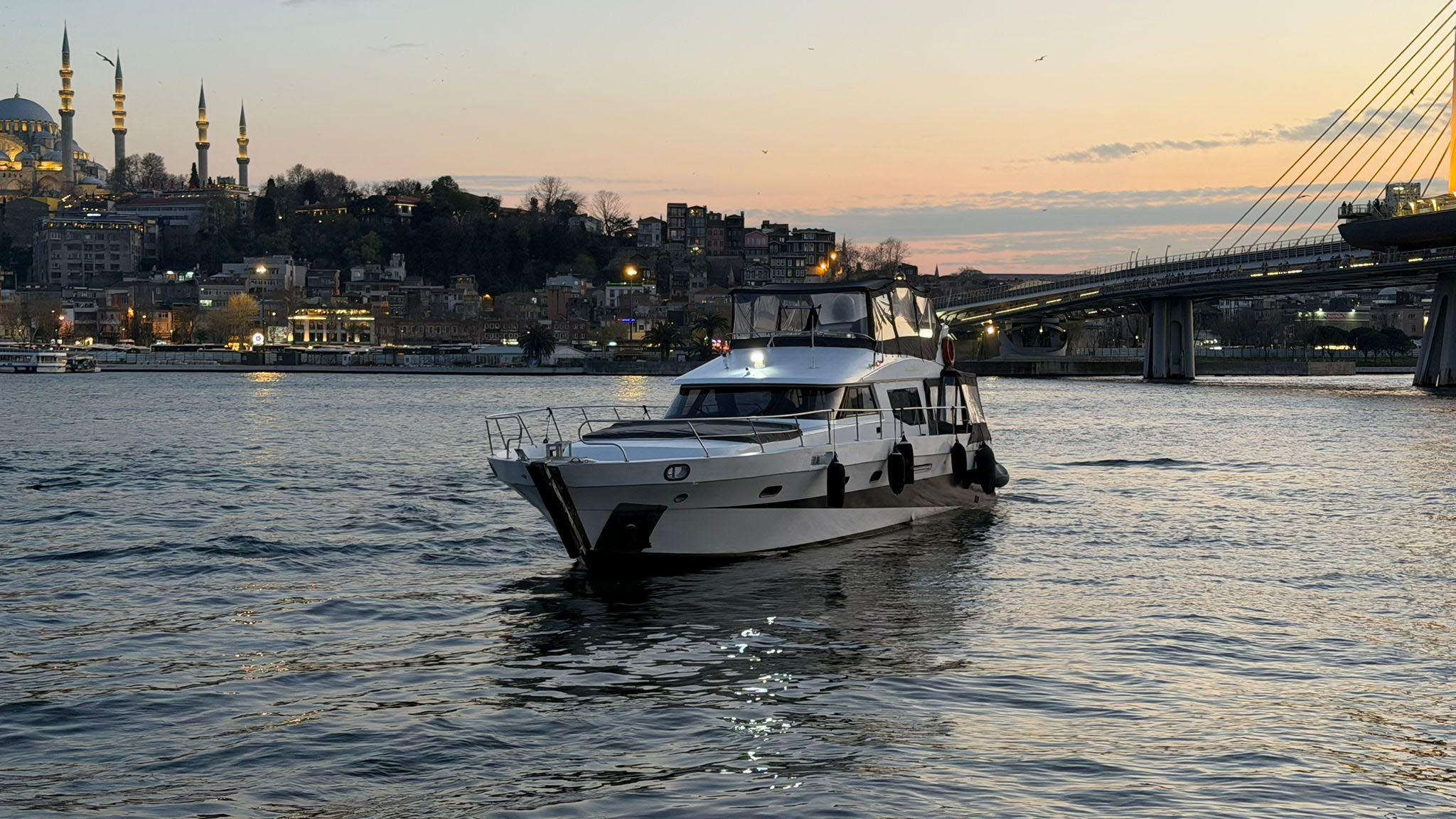
The Bosphorus Palaces Istanbul travelers see today — from Dolmabahçe to Beylerbeyi — are the marble chapter of an empire that decided, after four centuries, to leave its fortress for the water.
Eight palaces. One strait. The water the sultans called home.
For almost four centuries, Ottoman sultans ruled from Topkapı — a fortress-palace above the Golden Horn, landlocked and turned inward. In 1856, Sultan Abdülmecid I moved out. He crossed the water and built Dolmabahçe, and for the next sixty-six years the empire’s address was a line of marble palaces strung along the Bosphorus. Most of them are still there. A few are museums. One is a hotel. One burned down twice. Here is the coast they built.
1. Why the Sultans Moved to the Water
Topkapı was built in 1465, right after the conquest. It was a palace designed to look inward: courtyards within courtyards, harems behind walls, gates within gates. By the 1800s, that model felt medieval. European ambassadors arrived in steam ships and sent cables home. Railways reached Edirne. Paris had just been rebuilt. Sultan Abdülmecid — crowned at sixteen, educated in French — wanted an empire that faced outward. A palace you could arrive at by yacht.
He also wanted indoor plumbing.
The Bosphorus offered both. The strait was already the axis of imperial Istanbul: shipping, embassies, wealthy pashas’ waterfront mansions (yalı) lined both banks. Moving to the water meant moving into the nineteenth century. Between 1843 and 1907, every sultan after Abdülmecid built at least one palace, kiosk, or summer residence along the Bosphorus. The last one, Yıldız, became the seat of the empire’s final years before the Ottoman dynasty ended in 1922.
Key facts
- Topkapı was the imperial residence for 391 years (1465–1856).
- The move to Dolmabahçe was made official in 1856, thirteen years after construction started.
- Five sultans built on the Bosphorus: Abdülmecid I, Abdülaziz, Murad V (briefly), Abdülhamid II, Mehmed V.
- The last sultan, Mehmed VI, left Istanbul on a British warship from Dolmabahçe’s quay in 1922.
2. Dolmabahçe Palace — The First One on the Water
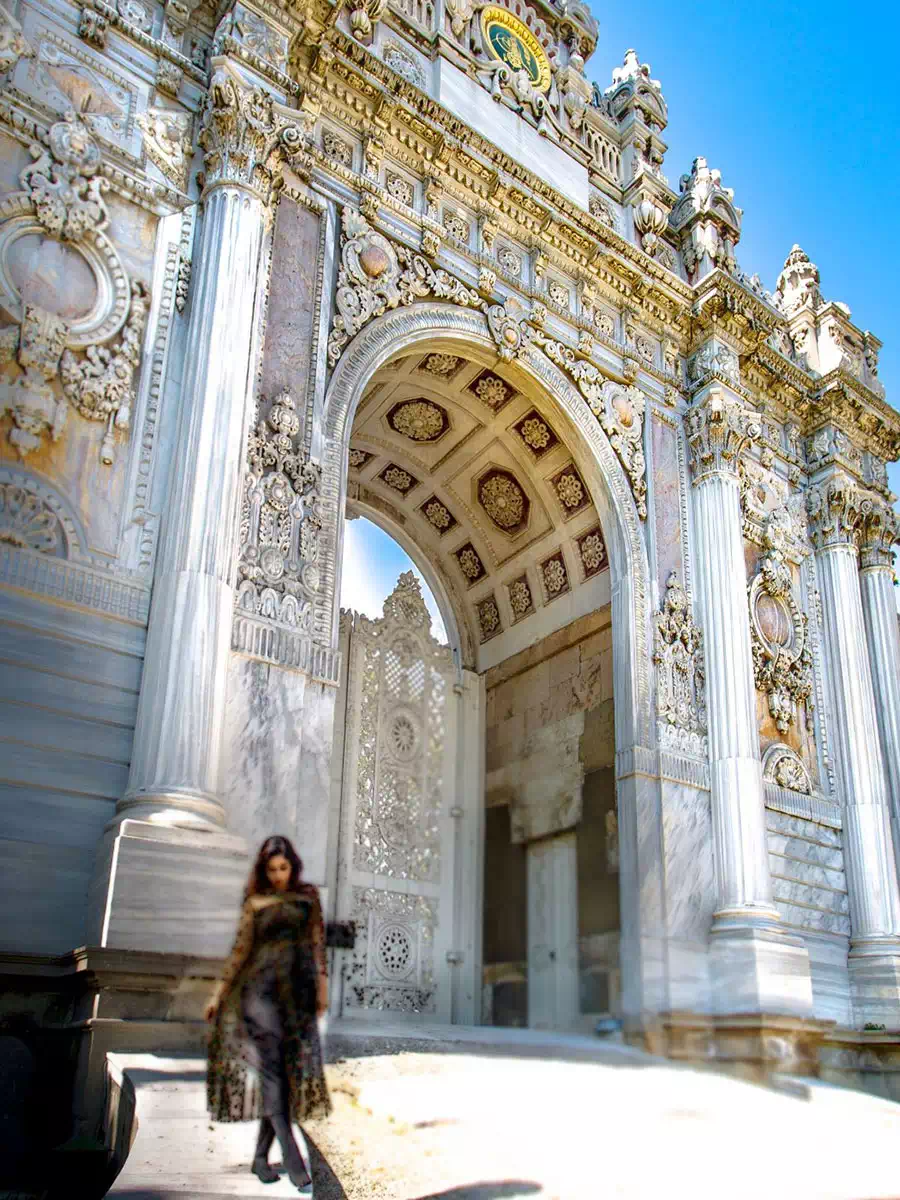
Dolmabahçe sits on the European shore in Beşiktaş, in what used to be a shallow bay that Ottoman oarsmen filled in by hand over two centuries — hence the name, “filled garden.” Construction ran from 1843 to 1856 under two Armenian architects, Garabet Balyan and his son Nigoğayos, who effectively designed half the imperial coastline over the following two generations.
The numbers are extraordinary: 285 rooms, 46 halls, 6 Turkish baths, 68 toilets, a 600-meter waterfront facade, and 14 tons of gold leaf used in the ceiling decoration. The central ceremonial hall — the Muayede Salon — holds a 4.5-ton Bohemian crystal chandelier with 750 lamps, one of the largest in the world. It was a gift, and the story that it came from Queen Victoria is told at the entrance even though the actual donor was never quite that clear.
The palace was built with five million Ottoman gold lira, roughly thirty-five tons of gold. The empire was already borrowing from European banks; Dolmabahçe is often cited as one of the accelerants of the 1875 state bankruptcy.
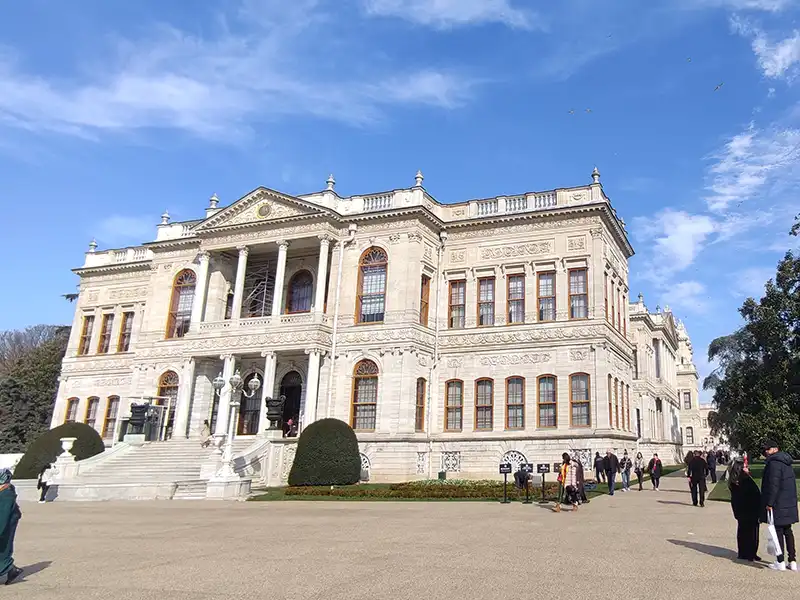
A national place of remembrance. On 10 November 1938, the founding father of the Republic (Atatürk) passed away in a room on the second floor of Dolmabahçe Palace. In his memory, every clock in the palace is set to 09:05, the hour of his passing. The room itself is preserved and visited in silence. Each year on 10 November, at 09:05, the entire country observes a minute of silence for Atatürk, and the ceremonies in Istanbul begin here, at Dolmabahçe.
For visitors, the interior pairs naturally with the view of the palace from the water — many itineraries combine a palace tour with a Bosphorus sightseeing cruise. A dedicated walk-through with a guide is offered by our Dolmabahçe Palace Tour.
Key facts
- Years: 1843–1856. Opened by Abdülmecid I.
- Architects: Garabet Amira Balyan and Nigoğayos Balyan.
- Rooms: 285, plus 46 halls.
- Chandelier: 4.5 tons, 750 lamps, Bohemian crystal.
- Gold used: 14 tons (decoration). Silver: 40 tons.
- National remembrance: clocks preserved at 09:05; a minute of silence observed across Türkiye every 10 November.
- Museum: open daily except Mondays.
3. Çırağan Palace — The One That Burned
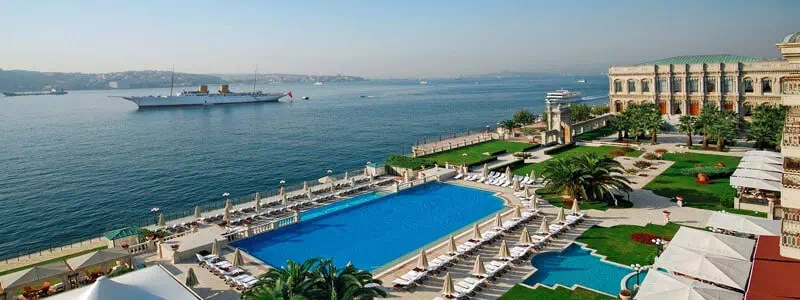
A kilometer north of Dolmabahçe, on the same European shore, stands Çırağan. Sultan Abdülaziz commissioned it in 1863 and moved in eight years later. It was the most expensive palace built in the empire’s last century — entirely marble-clad, with a facade so polished the light reflected off the water at dawn. Abdülaziz was the first Ottoman sultan to travel to Europe (Paris and London, 1867), and Çırağan reflected what he had seen.
He did not enjoy it for long. In 1876 he was deposed. His successor, Murad V, was himself deposed after ninety-three days and placed under house arrest inside Çırağan. He lived there until his death in 1904 — twenty-eight years inside the walls of the palace he had briefly owned.
A fire in January 1910 destroyed the entire interior in four hours. The marble shell stood empty for eight decades. In 1987 a Turkish–Kempinski partnership restored it as a luxury hotel, which is what it is today. You can walk into the lobby. You cannot see the original interior — nothing survived.
Çırağan is best appreciated from the water — the long white facade is fully visible on any northbound Bosphorus route. A private yacht sunset cruise passes close enough to read the balcony stonework.
Key facts
- Years: 1863–1871. Architects: Nigoğayos and Sarkis Balyan.
- Sultan: Abdülaziz.
- Facade: entirely white marble.
- Murad V held here: 1876–1904.
- Fire: 1910, interior destroyed in approximately four hours.
- Hotel conversion: opened 1992 as Çırağan Palace Kempinski.
4. Beylerbeyi Palace — The Summer House with Foreign Guests
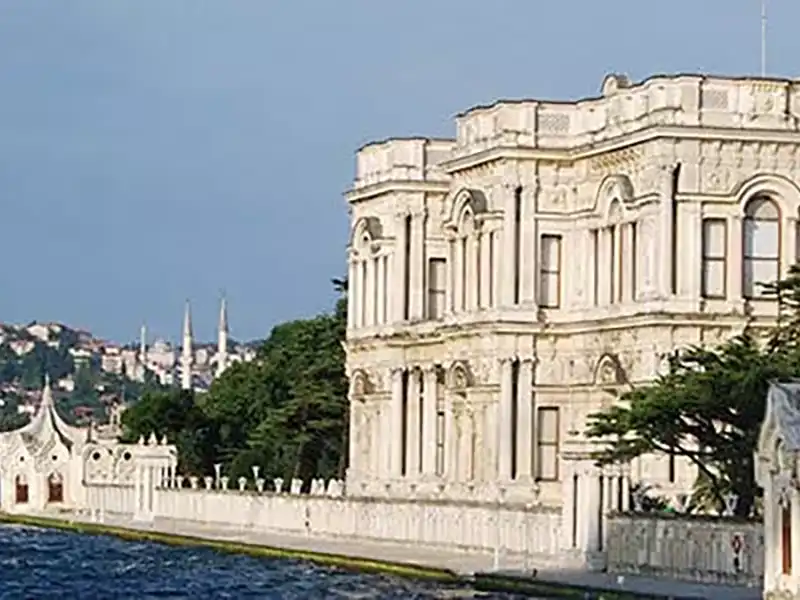
Cross to the Asian side, under the first bridge, and you reach Beylerbeyi. It is small by Dolmabahçe’s standards — 24 rooms, six halls — and it was never meant to be a full residence. Abdülaziz built it between 1861 and 1865 as a summer palace and, more specifically, as a place to host foreign dignitaries without moving the full imperial household.
The guest list is the interesting part. Empress Eugénie of France stayed here in 1869 on her way to the opening of the Suez Canal. Shah Nasereddin of Persia visited in 1873 and described the palace in detail in his travel journal. Edward VIII stayed. So did the King of Serbia. The palace’s reputation as a “diplomatic guesthouse” actually outlived the dynasty — in the early Republic, Turkey still lodged visiting royals here.
Beylerbeyi has two unusual features. One is the marine-themed entrance hall with a circular pool and a fountain — unusual because Ottoman palaces did not typically put water inside a building. The other: Abdülhamid II, the last Ottoman sultan to hold real power, spent the final six years of his life here under house arrest (1912–1918).
From the water, Beylerbeyi is directly below the 15 July Martyrs Bridge on the Asian shore — the moment most cruises pass under the first bridge, the palace is on the right. You see it best on a daytime Bosphorus cruise or private charter stop.
Key facts
- Years: 1861–1865. Architect: Sarkis Balyan.
- Sultan: Abdülaziz (as summer palace).
- Rooms: 24 + 6 halls. Function: diplomatic guesthouse.
- Famous guests: Empress Eugénie (1869), Shah Nasereddin (1873), Edward VIII.
- Last resident: Abdülhamid II under house arrest, 1912–1918.
5. Yıldız Palace — A Compound on the Hill
Yıldız is not one palace. It is a 500,000-square-meter park on the hill above Çırağan, filled with pavilions, workshops, greenhouses, and guard posts. Sultan Abdülhamid II moved the entire imperial household here from Dolmabahçe in 1877, the year after he took the throne. He believed — not without reason — that Dolmabahçe was too exposed to naval attack. Yıldız sat uphill, behind walls, ringed by loyal troops.
Abdülhamid II ruled for 33 years from inside this compound and almost never left. He ran the empire by telegraph. Yıldız had its own printing press, photography studio, and a porcelain factory founded in 1890 that still produces tableware today. The sultan himself was an accomplished carpenter; his woodworking workshop survives and contains furniture he built. The park held a small zoo. A theater. A library of 200,000 volumes.
The grandest building in the complex is Şale Kiosk — the “Chalet Kiosk” — built in Swiss-chalet style to host Kaiser Wilhelm II during his 1898 visit. The ceiling of its main salon weighs so much that engineers had to reinforce the foundation to hold it. Wilhelm stayed one night.
Yıldız is not visible from the Bosphorus directly — it is uphill. But the route from Ortaköy up to the Yıldız gate is walkable in twenty minutes, which is why many visitors combine a morning in the park with an afternoon on the water.
Key facts
- Park area: 500,000 m².
- Residence of Abdülhamid II: 1877–1909 (33 years).
- Porcelain factory: 1890, still operating.
- Library: 200,000 volumes at peak.
- Şale Kiosk: built 1898 for Kaiser Wilhelm II.
- Now houses the Yıldız Palace Museum and City Museum.
6. Küçüksu Pavilion — The Hunting Lodge

Downstream on the Asian side, between Beylerbeyi and Anadolu Hisarı, sits one of the prettiest small buildings in Istanbul. Küçüksu Pavilion — literally “little water” — was a hunting lodge and a place for short-afternoon rest. Abdülmecid commissioned it; Nigoğayos Balyan built it in 1857. Two floors, nine rooms.
The style is pure rococo. The exterior is stone carved to look like lace. The interior, restored in the 1990s, has walls covered in silver leaf — a detail no other surviving Ottoman palace has. The pavilion faces a small meadow at the mouth of two streams (the Sweet Waters of Asia), where Istanbul high society gathered for picnics in the late Ottoman period. Abdülhamid used to row over from Yıldız for solitary afternoons.
Küçüksu is passed by every cruise that goes beyond the second bridge. A dinner cruise on the Bosphorus doesn’t always reach this point, but a full-length Bosphorus and Black Sea cruise does.
Key facts
- Year: 1857. Architect: Nigoğayos Balyan.
- Size: 2 floors, 9 rooms.
- Style: rococo with silver-leaf interior walls.
- Purpose: hunting lodge / short-stay retreat.
- Nickname area: Sweet Waters of Asia.
7. Hıdiv Palace — The Egyptian Address
The northernmost palace on this list was not built by an Ottoman sultan at all. Abbas Hilmi Pasha II, the Khedive (“Hıdiv”) of Ottoman Egypt, built it in 1907 as his Istanbul residence. He picked a site most sultans had overlooked — the top of Çubuklu hill, on the Asian side, with panoramic views in both directions along the Bosphorus.
The style is Art Nouveau — Viennese Art Nouveau specifically, designed by Italian architect Delfo Seminati. The octagonal tower is the most recognizable feature. Inside there is an Italian marble staircase and a glass-roofed central hall lit by a skylight. The grounds include a small Roman-style swimming pool.
Abbas Hilmi lost his throne in 1914 when Britain deposed him; he lived in Switzerland until his death in 1944. The palace passed through several hands before Istanbul Municipality took it over in 1984. It operates today as a restaurant and events venue. The building is open to the public.
From a private yacht, Hıdiv is visible as a white tower above the trees when you pass Anadolu Hisarı going north — one of the last landmarks before the Bosphorus widens toward the Black Sea. A private yacht rental in Istanbul makes this stretch reachable.
Key facts
- Year: 1907. Architect: Delfo Seminati.
- Owner: Abbas Hilmi Pasha II, Khedive of Egypt.
- Style: Art Nouveau (Vienna school).
- Feature: octagonal tower, glass-roofed central hall.
- Current use: restaurant and municipal events venue (open to public).
8. The Lesser Pavilions — Ihlamur, Maslak, Adile Sultan
Three smaller buildings complete the coast. Ihlamur Pavilion in Beşiktaş (1849–1855) is two baroque pavilions in a linden grove — Abdülmecid used them for rest and private diplomatic meetings. Maslak Pavilions are a cluster of four small structures, now a museum, that Abdülhamid used as an agricultural experiment station. Adile Sultan Palace in Kandilli belonged to Mahmud II’s daughter, Princess Adile; it burned in 1986, was rebuilt, and now hosts cultural events.
None of them are as grand as Dolmabahçe or Beylerbeyi. All three are walkable, small enough to see in half an hour, and free of the crowds that fill the main palaces.
Key facts
- Ihlamur: 1849–1855. Two baroque pavilions in Beşiktaş.
- Maslak: cluster of four pavilions, now a museum.
- Adile Sultan: daughter of Mahmud II; burned 1986, rebuilt.
9. Bosphorus Palaces Istanbul: What You See from the Water
Most of these palaces sit on the water. Some are above it on a hill, visible but distant. A standard Bosphorus route — leaving from Kabataş or Galata and going upstream — passes them in this order:
- Dolmabahçe — about 10 minutes after departure, on the left (European side). White, with an ornate clock tower at the north end of the facade.
- Çırağan — immediately after Dolmabahçe. Also white marble, smaller, with hotel signage now.
- Yıldız — not visible from the water directly; uphill behind Çırağan.
- Beylerbeyi — about 20 minutes in, on the right (Asian side), directly under the first bridge.
- Küçüksu — 30 minutes in, Asian side, right after the second bridge.
- Hıdiv — on the hilltop on the Asian side, near Anadolu Hisarı. Visible from the water if the weather is clear.
A sunset route passes them in reverse light: Dolmabahçe glows gold on departure and the Asian palaces catch the last light an hour later. A night dinner cruise shows them lit from below — particularly Dolmabahçe, whose clock tower is illuminated year-round.
If you want to match the history to what you see, read this article once before you board and keep the palace order in mind when the boat turns. The four routes we operate pass these palaces in slightly different ways:
- 🌅 Bosphorus Sunset Cruise — Dolmabahçe to Küçüksu in golden hour light.
- 🍽️ Bosphorus Dinner Cruise — same route at night, palaces lit from below.
- ⚓ Private Bosphorus Yacht Cruise — slow down or stop at each palace for photos.
- 🛥️ Bosphorus and Black Sea Cruise — the only route that reaches Hıdiv and beyond.
10. Planning a Visit
A practical note rather than a price list — ticket prices change every year and are set by the national directorate (Milli Saraylar).
Opening pattern. Dolmabahçe, Beylerbeyi, and Küçüksu are all closed on Mondays. Yıldız and its grounds are open daily. Hıdiv is open daily (restaurant and grounds). Çırağan’s lobby is accessible anytime.
Crowd timing. Dolmabahçe fills up by 11 AM in summer — arrive at opening or after 3 PM. Beylerbeyi is much quieter; you can almost always walk in. Küçüksu rarely has a queue.
How long each takes. Dolmabahçe: three hours if you include the Harem section. Beylerbeyi: ninety minutes. Küçüksu: thirty to forty-five minutes. Yıldız (museum only): an hour. Hıdiv: as long as you want — the grounds and restaurant are free to walk in.
Combining palaces with a cruise. The cleanest one-day plan: Dolmabahçe at opening (9 AM), lunch in Ortaköy, then a Bosphorus sunset cruise from Kabataş that passes Çırağan, Beylerbeyi, and Küçüksu from the water. For two days: add Beylerbeyi in the morning of day two and finish with a long afternoon at Yıldız.
Tickets for the state-run palaces are sold at the gate, through the official Milli Saraylar website, and through operators that bundle skip-the-line access with a guide — this is how our own Dolmabahçe Palace Tour is structured.
Frequently Asked Questions
Which Bosphorus palace is the most worth visiting?
Dolmabahçe for scale and grandeur, Beylerbeyi if you want a palace you can see in ninety minutes without crowds. If you only pick one, Dolmabahçe. If you want the best-preserved interior, Küçüksu — its rococo rooms are the most intact in Istanbul.
Can you see all the Bosphorus palaces in one day?
You can see the exteriors of all of them on a single full-day Bosphorus route with a stop on the Asian side. Visiting the interiors of more than two in one day is not realistic — Dolmabahçe alone takes three hours.
Why did the sultans leave Topkapı?
Topkapı was a medieval palace by nineteenth-century standards: no running water, no carriage access, inward-facing courtyards. Sultan Abdülmecid I wanted a palace that could receive European ambassadors at the same diplomatic level as Versailles. Dolmabahçe was the answer.
Is Çırağan Palace open to the public?
Only as a hotel. You can walk into the lobby without being a guest. The original interior was destroyed in the 1910 fire; everything visible today was rebuilt between 1987 and 1992.
How do you get to Beylerbeyi Palace?
Ferry from Üsküdar to Beylerbeyi (fifteen minutes), then a ten-minute walk along the shore. By car, it’s directly under the 15 July Martyrs Bridge on the Asian side.
What’s the difference between Dolmabahçe and Beylerbeyi?
Dolmabahçe was the main imperial residence (1856–1922). Beylerbeyi was a summer palace and diplomatic guesthouse. Dolmabahçe is six times larger. Beylerbeyi is thirty years newer in decoration.
Are the palaces lit at night?
Dolmabahçe’s clock tower is illuminated year-round. The full Dolmabahçe facade is lit during major national holidays. Beylerbeyi, Çırağan, and Hıdiv are partially lit for their own reasons. A night Bosphorus cruise catches all of them from the water.
Which palaces have English tours?
Dolmabahçe and Beylerbeyi offer English audio guides. Guided group tours in English are scheduled several times daily at Dolmabahçe. Yıldız and Küçüksu have bilingual signage but no guided English tours.
Can you combine Dolmabahçe with a Bosphorus cruise?
Yes, and most visitors do. A morning at Dolmabahçe pairs naturally with an afternoon or sunset cruise that passes the rest of the palaces from the water. Our Dolmabahçe Palace Tour is built around exactly this combination.
What’s the best way to see the palaces from the water?
A Bosphorus sunset cruise passes Dolmabahçe, Çırağan, Beylerbeyi, and Küçüksu within the first forty minutes. A private yacht charter can slow down or stop near each palace for photos. Public ferries pass the same palaces but do not stop.
See the palaces as the sultans did — from the water.
Book your Bosphorus Sunset Cruise or explore our full list of Bosphorus tours.

